
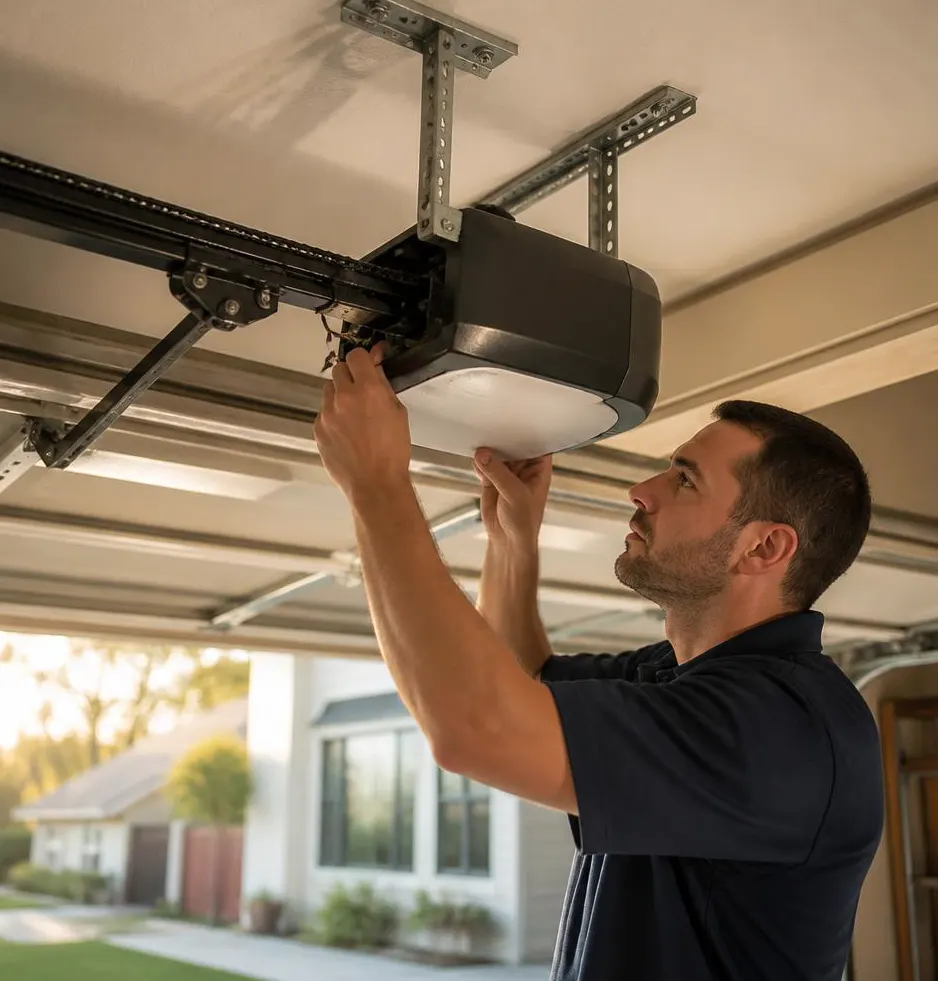
What a Technician Sees on a Typical Service Call
A homeowner calls because the opener "just stopped working." On arrival, the motor unit is warm to the touch, the gears inside have chewed themselves down, or the chain or belt has stretched and started slipping. Nine times out of ten, the opener didn't fail on its own — it was quietly straining against a garage door that lost its balance months earlier. Around Fairfax Station, this shows up more in late fall and winter, when cold air stiffens lubricant on the springs and tracks, and the door's true weight becomes harder for an already-struggling spring to manage. The opener compensates by working harder every single cycle, until something gives.
What an Unbalanced Door Does to the Opener
Garage doors are supposed to be counterbalanced by springs so that the door itself is nearly weightless when lifted by hand. The opener's motor was never designed to lift the full weight of a 150-to-400-pound door — it's only meant to provide a small push to get a balanced door moving. When a spring weakens or a door's weight distribution shifts (common in older homes with original hardware, or doors that have absorbed years of humid summers and icy winters), the opener has to do the spring's job as well as its own.
Over time, that extra load leads to: a burned-out motor or stripped drive gear, a stretched chain or belt that skips teeth, the door reversing or stopping partway through a cycle, and a remote or wall button that seems to work intermittently but actually reflects a safety sensor fighting excess strain. None of these are opener defects — they're symptoms of a mechanical imbalance upstream.
Tools You'll Need
- A step ladder (tall enough to reach the door's midpoint release handle)
- Work gloves
- A pencil or piece of tape to mark door position
- A flashlight to inspect springs and cables
How to Test Garage Door Balance: Step by Step
- Close the garage door completely. Make sure nothing is obstructing the track and the door is sitting flush on the floor.
- Locate the manual release cord (usually a red rope hanging from the trolley on the opener's rail) and pull it to disconnect the door from the opener. This step is essential — testing balance with the opener still engaged gives a false reading, since the motor will mask spring weakness.
- Lift the door manually to the halfway point, roughly waist height. Use the pencil or tape to mark that spot on the track or frame first, so you can judge the position accurately.
- Let go of the door and watch what happens. A properly balanced door will stay exactly where you left it, or drift down just an inch or two before settling. It should feel light in your hands the entire way up, almost like lifting an empty cardboard box.
- Note any red flags: the door slams shut, drifts rapidly to the floor, shoots upward on its own, or feels noticeably heavier on one side than the other. Any of these means the springs are no longer matched to the door's weight.
- Reconnect the opener by pulling the release cord again (or following the trolley back into place per your opener's manual) before using the door normally again.
What a Homeowner Can Safely Do
The test above is safe for most homeowners because it involves only the door itself — no spring adjustment, no tension changes. While you're up there, it's also reasonable to visually inspect the torsion spring above the door for visible gaps in the coil, rust, or a spring that looks stretched compared to its neighbor on a two-spring setup. You can also check that rollers move freely in the track and that hinges aren't visibly bent, since either can throw off balance readings without being a spring issue at all.
What Needs a Technician
If the door fails the balance test, the fix is spring adjustment or spring replacement — and this is not a DIY repair. Torsion springs are wound under extreme tension (often several hundred pounds of force) and are the single most common cause of serious garage door injuries when handled without the right winding bars and training. Extension springs carry similar risk if they fail while under load. If your test revealed a door that's heavy, drifting, or uneven, that's the line where a homeowner's job ends and a technician's begins.
When to Call Fairfax Station Garage Door
If your door fails this test, or if you've already noticed an opener struggling — grinding noises, slow operation, or a door that reverses for no clear reason — it's time to call before the opener itself needs replacing. Our technicians carry the correct spring sizes and winding tools for both torsion and extension systems, and we'll diagnose whether a simple spring adjustment will restore balance or whether the springs have reached the end of their service life and need spring replacement. We also offer garage door opener repair for units that have already taken damage from months of fighting an unbalanced door, and we can tell you honestly whether the motor is salvageable or due for replacement. Either way, we check balance as a standard part of the visit, so you're not paying to fix the symptom while the actual cause goes untouched.
If your garage door feels heavy, uneven, or your opener has been working harder than it should lately, call Fairfax Station Garage Door today. We serve Fairfax Station, VA and the surrounding area with honest diagnostics and no-surprise pricing — get it checked before winter puts more strain on a door that's already out of balance.